Views: 0 Author: Site Editor Publish Time: 2026-05-27 Origin: Site
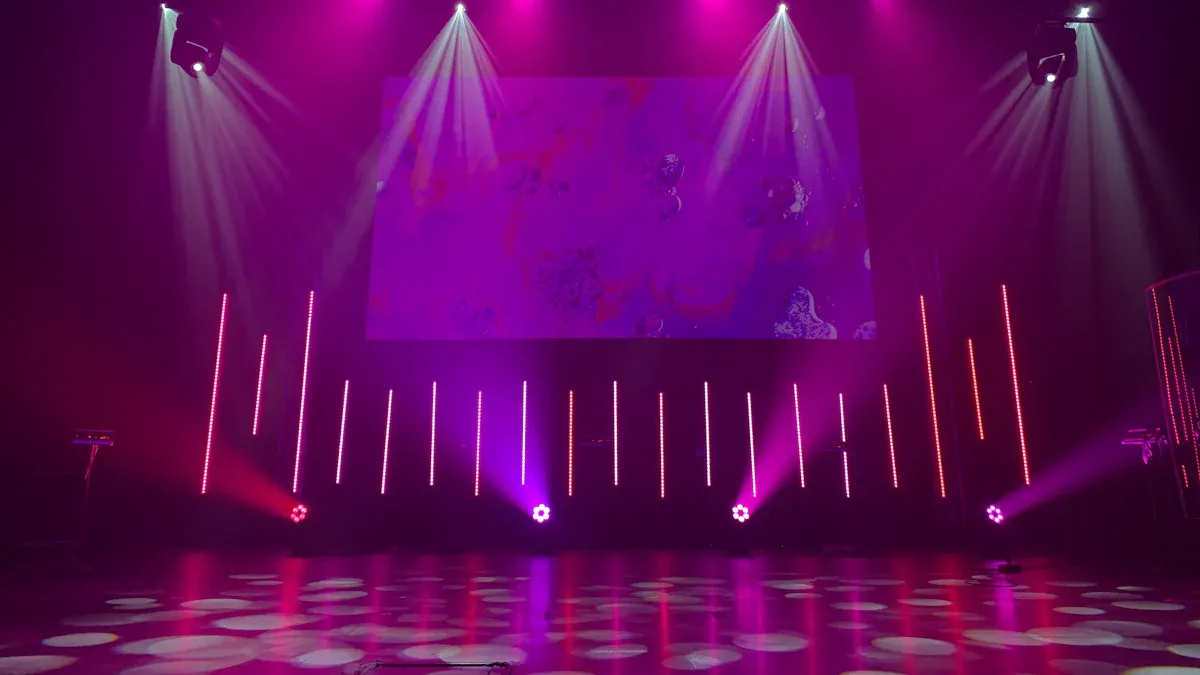
You use LED stage lights to light up shows with bright colors and clear effects. These lights use LED technology. This lets you control red, green, and blue light on their own. When you mix these colors, you make new shades. You can also make white light. This is called additive color mixing. LED stage lights help change the stage. They make the show exciting for people watching. They save energy, last longer, and give off less heat.
Benefit | Description |
|---|---|
Energy Efficiency | LEDs use less power, so they save energy. |
Longer Lifespan | LED lights last longer and need fewer changes. |
Reduced Heat Emission | LEDs make the stage cooler and safer. |
LED stage lights use less power. This saves money on electric bills. It also helps the environment.
These lights last longer than regular bulbs. This means you spend less time fixing them. It also lowers costs.
You can make many colors with LED lights. This lets you create fun and cool stage effects.
LED stage lights do not get very hot. This makes the stage safer. It is also more comfortable for people performing.
Smart controls help you manage the lights easily. You can change the lights fast during live shows.
Stage lighting makes a show look better. It helps you see what is happening. LED stage lights can highlight actors and props. You can change how bright or colorful the lights are. This lets you make strong differences or smooth mixes. Stage lighting design helps you guide where people look.
Dr. Sarah Jenkins says your eyes notice light before you think about it. Stage lighting design can change your experience without you knowing.
A study from the Event Production Institute in 2023 showed that small lighting changes can raise heart rates by up to 7 beats per minute.
Stage lighting design helps show shapes, set the scene, and add texture.
Lighting systems help you control focus and build feelings.
Stage lighting design makes performances more fun. You can show movement or stop a moment. You can make the stage look bigger or smaller. Light helps show what is important.
Stage lighting design lets you change how a show feels. Lighting systems can make the stage feel warm, tense, or exciting. You can use a soft amber light to make things gentle. You can use a cool blue spotlight to add suspense. Stage lighting design helps show changes in time or mood.
Lighting creates the feeling of an event. It affects what you remember.
Small lighting changes can raise your heart rate without you noticing.
Tiny lighting choices can change how you feel and react.
Stage lighting design helps build mood and guide feelings. You make the stage lively with light. You help the audience feel the story. Stage lighting design gives you ways to make moments people will remember.
When you look at the different types of led fixtures used on stage, you see that each one has a special job. You can choose from several types of stage lights to create the right effect for your show.
PAR cans, or Parabolic Aluminized Reflectors, give you strong, oval-shaped beams. You can use them for both general lighting and accent effects. Their compact size and wide color range make them a favorite for many events. Unlike other types of stage lights, PAR cans do not create sharp edges. You get a smooth wash of color across the stage. This makes them perfect for concerts, school plays, and even outdoor events.
Moving heads are the most popular choice in professional productions. You see them in about 50% of stage lighting setups. These fixtures stand out because they move in many directions. You can pan and tilt them to follow performers. Moving heads let you change colors quickly and project patterns or logos. You can also adjust the beam shape and store lighting scenes for later use.
Automated movement tracks performers.
Color changing uses built-in wheels or mixing systems.
Pattern projection displays shapes and logos.
Beam shaping lets you zoom and focus.
Programmable sequences save complex lighting effects.
Battens and borderlights help you blend and tone the stage. You often find them above or beside the acting area. These fixtures use several color circuits, so you can mix colors and create soft washes. Their main job is to unify the look of the stage and avoid harsh shadows.
Function/Characteristic | Description |
|---|---|
Blending and Toning | Borderlights blend and tone stage lighting, giving low general illumination. |
Color Mixing | Multiple color circuits let you create many tones. |
Positioning | You place them to light the acting area without shining on scenery. |
Floodlights cover large areas with a wide beam. You use them when you want to light up the whole stage. Spotlights, on the other hand, create a narrow, focused beam. You use them to highlight a singer or actor. Floodlights do not have lenses, so you cannot control the beam shape much. Spotlights give you more control and help you draw attention to key moments.
Feature | Floodlights | Spotlights |
|---|---|---|
Beam Angle | Wide beam angle | Narrow beam angle |
Intensity | Lights up large areas | Highlights specific areas or people |
When you pick from the different types of led stage lights, you can shape the mood, focus, and energy of your show.
LED stage lights use special parts called semiconductors to make light. When you turn on the light, electrons and holes come together inside the semiconductor. This makes energy that turns into visible light. The color depends on what material is inside the LED. Gallium nitride lets you change the color for different effects. You can get red, green, blue, or white light.
The light’s wavelength comes from the energy in the semiconductor.
You change the color by adjusting the material’s band gap.
Good conditions help the LED shine bright and work well.
Semiconductors make light when electrons and holes join.
Materials like gallium nitride help you pick your color.
New technology lets you make white LEDs that look like daylight.
These advances help LED fixtures work well and show bright colors. This makes stage lighting design more creative and flexible.
Additive color mixing lets you make almost any color on stage. LED stage lights use red, green, and blue LEDs to mix colors. This is called RGB. Some lights add amber or white LEDs for more choices. RGBA gives warmer tones. RGBW helps show skin tones better.
RGB mixing uses red, green, and blue LEDs.
RGBA adds amber for richer colors.
RGBW adds white for better color accuracy.
You control each color channel to get the shade you want. Accurate dimming helps colors change smoothly. PWM dimming controls brightness. Most stage lighting uses DMX512 to manage color and brightness. This system gives you exact control over your lights.
Tip: RGBA or RGBW systems help match colors to costumes and scenery.
The way your LED fixture is built affects your lighting quality. The optical system inside controls the beam angle and focus. You can pick a wide wash or a tight spotlight. Some fixtures let you move the beam or change its shape. This helps you follow performers or highlight moments.
The optical system sets the beam angle and focus.
The color system mixes colors with wheels or filters.
The gobo system projects patterns and shapes.
Motion systems let you move the light during a show. This adds excitement and keeps the audience interested. Stage lighting design uses these features to make dynamic effects. You can mix colors, project patterns, and change the mood with one fixture.
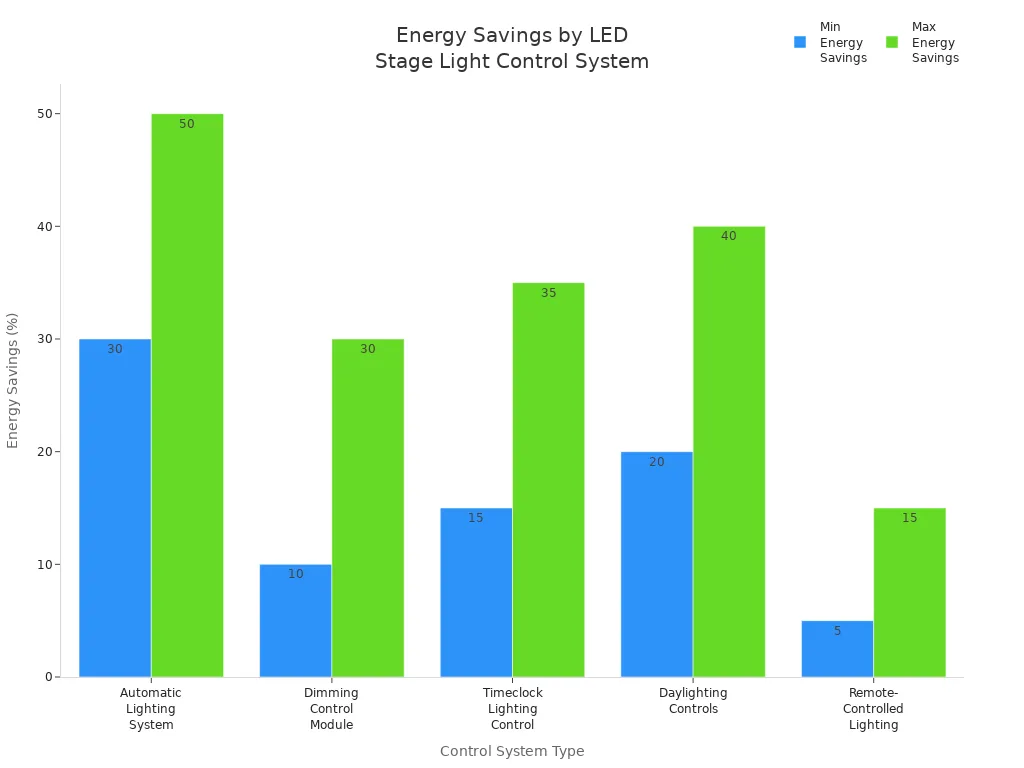
LED stage lights help you save energy. Modern lighting systems use smart controls to be even more efficient. Automatic systems turn lights on or off when people move. Dimming modules let you change brightness for each scene. Timeclock controls run lights only at certain times. Daylighting controls use sunlight to cut down on power use. Remote systems let you control lights from far away.
Control System Type | Energy Savings (%) | Description |
|---|---|---|
Automatic Lighting System | 30-50% | Turns lights on/off when people are there, saving energy. |
Dimming Control Module | 10-30% | Changes brightness for each scene or user. |
Timeclock Lighting Control | 15-35% | Runs lights only at set times, so less waste. |
Daylighting Controls | 20-40% | Uses sunlight to lower artificial lighting. |
Remote-Controlled Lighting | 5-15% | Lets you manage lights from anywhere, so you use only what you need. |
Smart lighting systems are common in stage lighting design. You can use your phone or tablet to control the lights. This is helpful during live events or festivals. You can make quick changes and keep your show running smoothly. These features help you save energy and money.
LED stage lights use advanced technology, creative design, and smart controls. This gives you strong tools for stage lighting design and helps you make shows people remember.
You can save a lot of energy with led stage lights. These lights use much less power than old lighting systems. For example, if you change from a 575W tungsten fixture to a 150W led fixture, you can save up to 74% energy. This means you pay less for electricity on your stage.
You lower your energy bills.
You do not need big power supplies.
You help the planet by using less energy.
Led stage lights also help cut down carbon emissions. Big concert tours have seen their carbon footprint drop by 50-70% after switching to led technology. These lights make less heat, so you do not need as much cooling. This saves even more energy. When you use led stage lights, your stage lighting design is greener and saves money.
Note: Using energy-saving lighting is one of the easiest ways to make your stage better for the environment.
Led stage lights last much longer than old lights. You can expect them to work for 30,000 to 100,000 hours. In many theaters, led lights only need to be changed after about 60,000 hours. Halogen or incandescent lights may last only 1,000 to 5,000 hours.
Light Type | Average Lifespan (hours) |
|---|---|
LED | 30,000 - 100,000 |
Halogen | 2,000 - 4,000 |
Incandescent | 1,000 - 5,000 |
You spend less time and money fixing led stage lights. You do not need to change bulbs often. This means fewer breaks during shows and less work for your crew. Old lights get hotter, which can cause overheating and broken equipment. Led fixtures stay cooler, so you have fewer repairs and a safer stage.
Led lights last 25,000 to 50,000 hours or more.
You spend less time and money on maintenance.
Fewer replacements mean less waste and less harm to the environment.
Led stage lights give you more choices for stage lighting design than old fixtures. You can change color and brightness right away. You do not need to swap filters or use many lights for different effects. One led light can do the job of several old lights, making setup faster and easier.
You can make lights flash to music, change colors for each scene, and follow actors as they move.
Effects like color fades, strobing, and smooth color mixing happen fast and easy.
Led stage lights let you try new ideas, program cool effects, and make changes during the show.
Lighting designers like how flexible led stage lights are. You can make hard color changes and transitions that are tough with old lights. Good led fixtures have a color rendering index (CRI) of 90 or more. This means you see true skin tones and costume colors on stage.
Feature | Benefit |
|---|---|
Dynamic Control | Lets you try creative ideas and make cool effects in shows. |
Color Versatility | Makes smooth color changes and complex color patterns. |
Programming Capability | Cuts down on work and makes live shows run better. |
When you compare led stage lights to old lighting, you see clear benefits. Led fixtures use less energy, last longer, and give you more creative control. You also spend less on fixing and cooling. The first cost may be higher, but you save money over time.
Tip: If you want flexible, efficient, and creative stage lighting, led stage lights are your best pick.
You get lots of benefits with LED stage lights. These lights use less power and last a long time. You can pick from millions of colors. This helps you make cool effects for concerts, plays, or business events. Many places use LEDs for these reasons:
Reason for Adoption | Application |
|---|---|
Energy efficiency | Saves money and keeps the stage cooler |
Versatile lighting | Lets you be creative for any show |
High-quality illumination | Makes the stage bright and clear for everyone |
If you want lighting that is flexible and saves energy, try LED stage lights at your next event. If you have questions, write them below!
You get more color choices and energy savings with LED stage lights. These lights last longer and stay cooler than old bulbs. You can control them easily for quick changes during a show.
Yes, you can use many LED stage lights outside. Look for fixtures with weatherproof ratings like IP65. These lights work well for concerts, festivals, and outdoor events.
You use a lighting console or DMX controller. This lets you mix red, green, and blue to make new colors. You can also set scenes, fades, and effects with simple controls.
You do not need much maintenance. Clean the lenses and fans sometimes. Check cables and connections before each show. LED fixtures do not need bulb changes as often as old lights.