Views: 0 Author: Site Editor Publish Time: 2026-10-13 Origin: Site
Producing an event outdoors introduces variables that indoor venues completely eliminate. Unpredictable weather patterns, uneven terrain, and a lack of built-in power infrastructure can instantly compromise a production. When the sun goes down, the stakes rise. Production managers face a constant tension between aesthetic demands and technical realities. Deploying inadequate fixtures often leads to catastrophic power failures, severe safety hazards, or washed-out visuals that fail to translate on camera or in person.
You need a strict technical evaluation framework to select the optimal mix of equipment. Choosing the right outdoor event lighting dictates the structural safety and visual success of the entire site. We will evaluate site constraints, balance power loads, and choose between untethered fixtures and heavy-duty IP-rated units for reliable, compliant deployments.
IP Rating is Non-Negotiable: IP65-rated fixtures are the baseline for true outdoor reliability, protecting against both dust ingress and low-pressure water jets.
Battery vs. Output Trade-off: Battery lights offer rapid, cable-free deployment but require strict calculations regarding run-time, lumen output, and temperature-induced battery degradation.
Infrastructure Dictates Fixture Choice: Site power availability and generator capacity must be audited before finalizing the lighting plot, heavily influencing the split between hardwired and battery-operated units.
Safety and Compliance First: Proper cable management, load balancing, and weather-sealed connections are critical to mitigating liability and ensuring uninterrupted performance.
Table of Contents
Ingress Protection (IP) ratings indicate a lighting fixture's resistance to dust and water, helping determine its suitability for indoor and outdoor applications. IP20 fixtures are intended for dry indoor environments, IP44 provides splash protection, IP65 protects against dust and water jets, and IP67 withstands temporary immersion under specified conditions. For exposed outdoor stages, purpose-built IP65 or higher-rated fixtures are generally preferable to indoor lights with temporary weather covers, which may restrict cooling and cause overheating.
Every successful deployment begins with a rigorous technical site survey. You must map the physical landscape before selecting a single fixture. The survey identifies the exact locations of generator placements, shore power access points, and the required cable run distances. Long cable runs introduce voltage drop, which can cause intelligent fixtures to malfunction or reset unpredictably.
Execute the following steps during your site survey:
Locate all generator drop zones and verify ground stability for heavy equipment.
Measure exact cable run distances from power distribution racks to the furthest fixture.
Assess terrain load-bearing capacity for truss towers and base plates.
Identify potential pedestrian bottlenecks where cable ramps will be required.
Terrain heavily impacts rigging and fixture placement. Concrete surfaces allow for heavy base plates and stable truss towers. Grass and soil require ground load distribution to prevent sinking. Sand introduces severe particulate hazards, necessitating IP65 gear even if rain is not in the forecast. Success criteria depend entirely on aligning your equipment choices with the physical realities of the site.
Outdoor spaces lack the reflective walls and ceilings found in ballrooms. Light dissipates rapidly into the night sky. The inverse square law dictates that as the distance from the light source doubles, the intensity of the light drops to one-quarter of its original strength. You must compensate for this physics principle by deploying fixtures with significantly higher lumen outputs than you would use indoors.
Competing with ambient light requires establishing strict baseline lumen requirements. Dusk, nearby streetlights, and full moonlight all wash out low-output fixtures. Stage washes typically require fixtures pushing upwards of 10,000 lumens to maintain visibility. High output must not compromise color quality. Evaluate the Color Rendering Index (CRI) and TM-30 scores of your fixtures. High-output LEDs can sometimes produce a harsh, unnatural spectrum. A CRI above 90 ensures that skin tones look natural on camera and scenic elements retain their intended hues. Poor color rendering turns vibrant wardrobe choices into muddy, desaturated visuals.
Labor efficiency drives many production decisions. Deploying Battery Lights eliminates the need to run hundreds of feet of power and data cables. This rapid deployment drastically reduces setup and strike times. A crew can position fifty untethered uplights across a sprawling estate in a fraction of the time it takes to wire a traditional rig.
Aesthetics play an equally important role. High-end corporate events and weddings demand pristine environments. Cable visibility is often a dealbreaker for clients paying for immersive scenic design. Untethered fixtures maintain clean sightlines. Integrating Wireless DMX (W-DMX) allows lighting directors to maintain fully untethered control, triggering complex chases and color fades without a single data run.
Untethered fixtures come in several distinct form factors, each suited to specific applications. Mapping the form factor to the application ensures you do not waste battery capacity on the wrong task. A compact brick cannot wash a 30-foot tree, and a traditional PAR is too bulky to hide along a narrow garden path.
Form Factor | Primary Application | Deployment Strategy |
|---|---|---|
Traditional PARs | Architectural uplighting, tree washing | Place at the base of large structures for strong, directional beams. |
LED Tubes | Geometric stage designs, eye candy | Mount on vertical floor stands or rig overhead for pixel-mapped effects. |
Compact Bricks | Pathway illumination, truss warming | Hide inside box truss or place along pedestrian walkways for safety. |
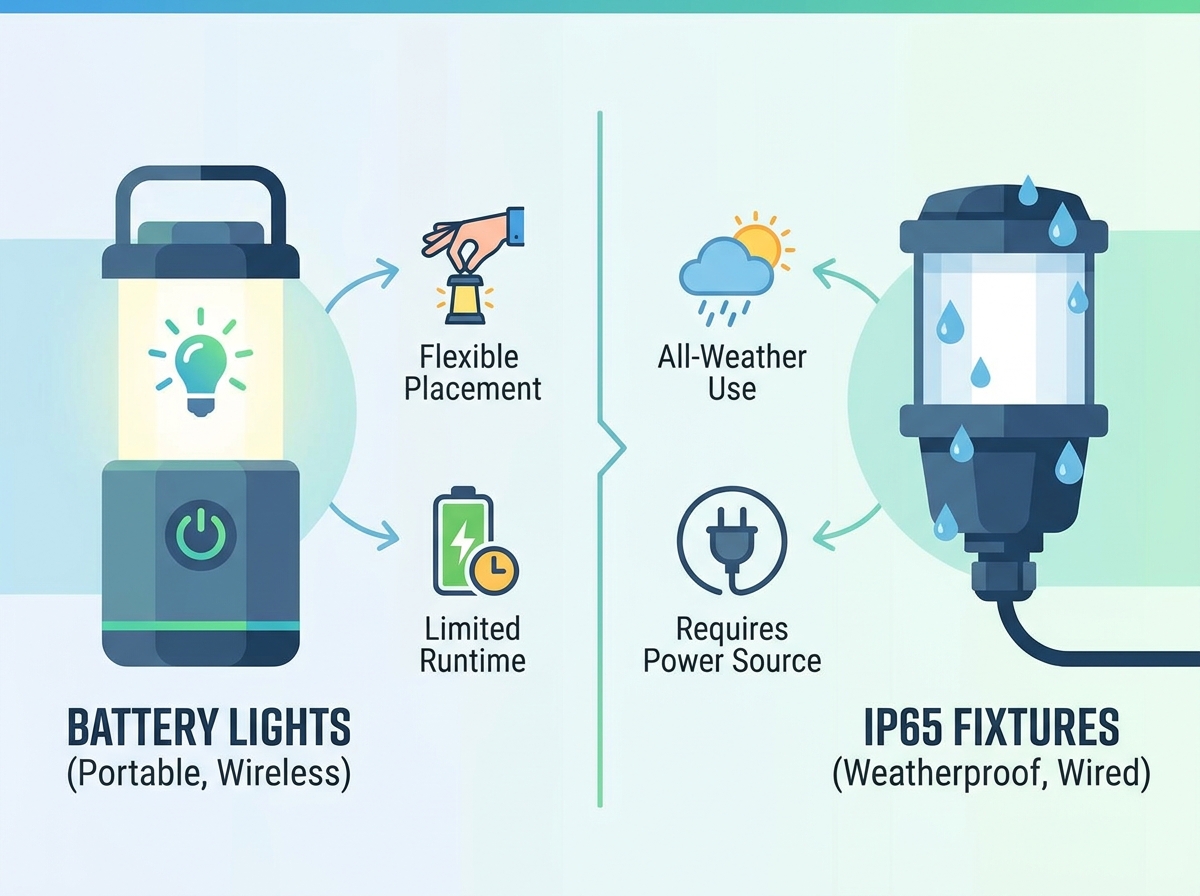
Battery-powered lighting fixtures offer flexible installation but have limitations in runtime, brightness, and environmental performance. Higher light intensity increases power consumption, while cold temperatures can reduce battery capacity. These fixtures are ideal for decorative and accent lighting, but demanding stage applications may require hardwired alternatives.
Selecting reliable battery-powered fixtures requires evaluating battery capacity, actual runtime, charging speed, and wireless control performance. Compare full-white and single-color operating times, check battery cycle life, and verify compatibility with reliable wireless DMX systems such as CRMX or LumenRadio-based solutions.
IP65-rated lighting fixtures provide dust-tight protection and resistance to water jets, making them suitable for many exposed outdoor applications. They are commonly used for festivals, architectural lighting, and uncovered stages. Weather-resistant power and data connections are essential, and all equipment should be operated within its specified environmental limits.
Outdoor lighting installations require different fixture types to achieve suitable stage coverage and visual effects. IP-rated moving heads provide dynamic lighting, LED blinders create audience-facing effects, and architectural wash lights illuminate large surfaces. Fixture selection should consider beam angle, output, throw distance, and environmental protection.
IP65 lighting fixtures often require more robust enclosures and sealing systems, which can increase equipment weight and cost. Additional weight affects truss capacity, mounting hardware, and transportation requirements. Buyers should balance weather protection, installation complexity, maintenance needs, and overall project budgets.
Front of House (FOH) control equipment requires reliable weather protection during outdoor events. Lighting consoles, network switches, and UPS systems should be installed in suitable sheltered or weather-rated enclosures. Protecting Art-Net and sACN connections helps prevent moisture-related failures and maintain stable lighting control.
Outdoor lighting power distribution requires accurate calculation of fixture loads, startup current, and generator capacity. Three-phase systems should distribute loads appropriately to minimize voltage imbalance and maintain stable operation. Proper generator sizing and electrical monitoring help prevent overloads, flickering, and equipment damage.
Proper cable management improves safety and signal reliability during outdoor productions. Use heavy-duty cable protectors in pedestrian and vehicle areas, secure connections, and separate power cables from sensitive DMX or audio lines where practical. Careful routing reduces tripping hazards, cable damage, and electromagnetic interference.
Electrical safety is essential for outdoor lighting installations. Proper protective grounding, suitable GFCI or RCD protection, and weather-rated connectors help reduce electrical hazards. Power distribution equipment should be protected from standing water, with all installations following applicable electrical regulations and manufacturer requirements.
Renting or purchasing outdoor lighting equipment depends on event frequency, utilization, and long-term operating costs. Purchasing may offer better value for companies handling frequent productions, while renting reduces upfront investment for occasional events. Battery replacement, maintenance, transportation, and storage should also be considered.
Reliable lighting suppliers and rental companies should provide verified equipment specifications, maintenance records, and dependable technical support. Before sourcing outdoor fixtures, confirm their IP ratings, battery condition, cable integrity, and previous outdoor application experience to reduce equipment failures during events.
Outdoor lighting maintenance includes regular cleaning, inspection of weatherproof seals, firmware updates, and electrical connection checks. Battery-powered fixtures also require proper charging, storage, and battery health monitoring. Preventive maintenance helps preserve fixture performance, weather resistance, and long-term reliability.
Successful outdoor event lighting demands a hybrid approach. Relying solely on one type of fixture limits your flexibility and exposes the production to unnecessary risks. The most effective designs leverage untethered fixtures for rapid, cable-free peripheral aesthetics while reserving heavy-duty IP65 hardwired fixtures for critical, high-output stage and structural lighting. By balancing these technologies, production teams can deliver stunning visuals without compromising safety or reliability.
To execute a flawless outdoor deployment, take the following actions:
Conduct a comprehensive physical site survey to map terrain, cable paths, and generator locations.
Calculate total amperage loads and balance them evenly across all generator phases.
Establish hard weather thresholds and write a clear evacuation and power-down protocol.
Consult with a specialized AV vendor to verify the maintenance history and true IP ratings of all rented inventory.
A: IP65 is the industry standard for outdoor event lighting. It ensures the fixture is completely dust-tight and protected against low-pressure water jets from any direction. This rating allows fixtures to survive heavy rainstorms and dusty festival environments without internal damage.
A: Run times vary drastically based on usage, typically ranging from 4 to 12 hours. Running a fixture at 100% intensity on all colors drains the power quickly. Operating a single color at lower intensities extends the life. Cold weather also significantly reduces realistic run times.
A: Using IP20 indoor fixtures outdoors is highly risky. Even when protected by plastic weather domes or bagging, they are prone to overheating due to restricted airflow. If moisture breaches the plastic, it causes short circuits, creating severe safety hazards and liability issues.
A: Uncontained outdoor spaces require high output because there are no walls to reflect light. Ambient wash lighting generally requires fixtures producing 2,000 to 5,000 lumens. Primary stage spotlighting and long-throw washes often require fixtures pushing 10,000 to 20,000 lumens to compete with ambient streetlights.
A: Yes. Cold temperatures slow down the chemical reactions inside lithium-ion cells. This increases internal resistance and reduces the battery's capacity to discharge power efficiently. Fixtures operated in near-freezing conditions will experience significantly shorter run times than their advertised specifications.
A: Use IP-rated cables like True1 or Seetronic for primary connections. For standard cables, elevate junction boxes off the ground, apply dielectric grease to the prongs, and use specialized plastic shrouds. Always ensure the circuit is protected by a GFCI or RCBO breaker.