Views: 0 Author: Site Editor Publish Time: 2026-09-04 Origin: Site
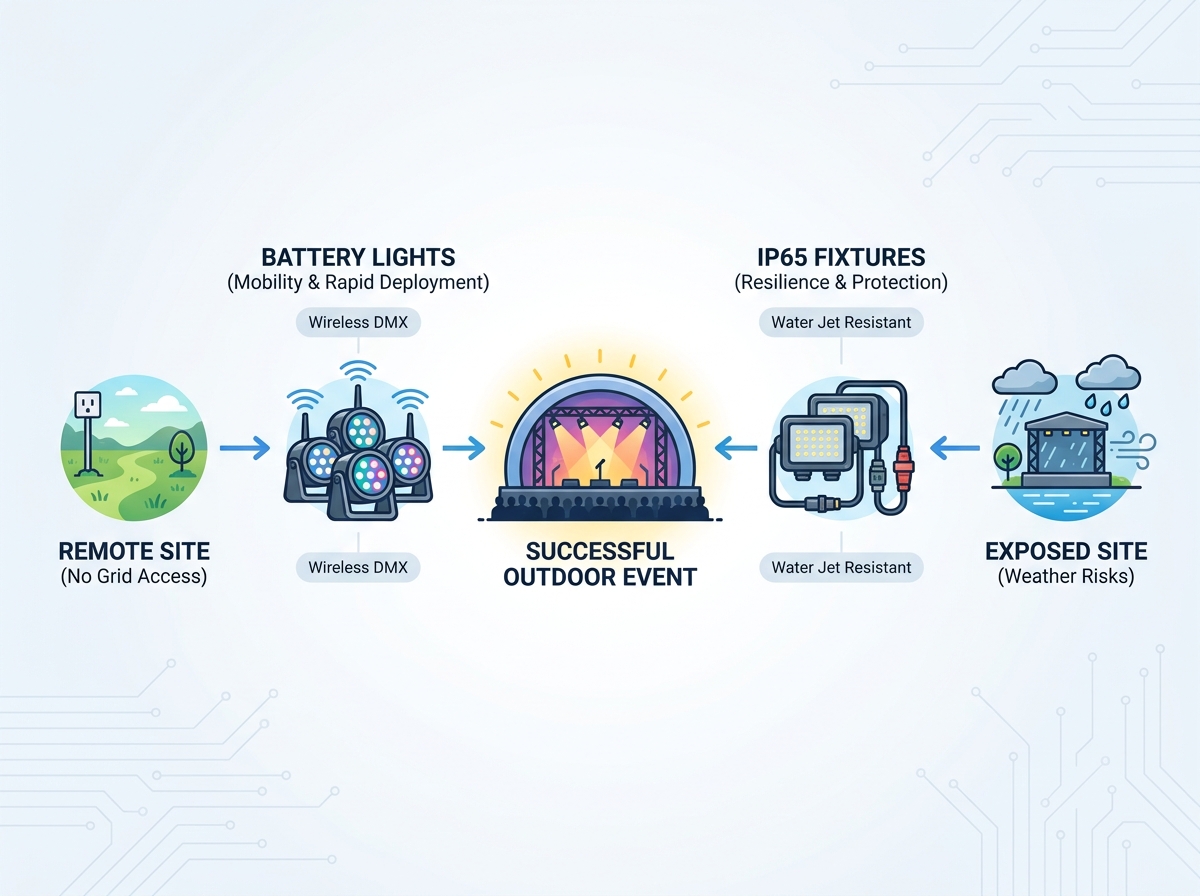
Outdoor event lighting failures carry immense financial and reputational risks. A sudden downpour can quickly turn a spectacular show into a technical nightmare. Unmapped power constraints at remote venues often derail otherwise flawless production schedules. AV production managers, mobile event services, and technical directors constantly face these unpredictable elements. Making the right purchasing or rental decision dictates whether a production survives adverse conditions. You need equipment capable of weathering severe storms while operating independently of unreliable grid access. Successful outdoor lighting deployment requires balancing power autonomy through wireless solutions alongside the environmental resilience of IP65 ratings. This guide explores how to evaluate site constraints, select appropriate fixtures, and mitigate critical safety risks. You will learn actionable strategies to maximize operational efficiency and ensure strict safety compliance at your next outdoor event.
Establishing baseline requirements remains a critical first step before reviewing specific equipment specifications. Production teams often rush into selecting fixture models. Instead, you must first evaluate the physical and logistical limitations of the venue itself. Understanding these constraints prevents costly mid-event failures.
You must differentiate between standard grid access, generator reliance, and completely remote sites. Urban festivals often provide reliable grid tie-ins. These locations support traditional wired fixtures easily. Conversely, generator-reliant sites introduce voltage fluctuations. Generators require careful load balancing across phases to prevent breaker trips. Completely remote sites present the biggest challenge. Craft fairs, pop-up stages, and historic venues frequently prohibit cable runs across public walkways. These environments demand complete power independence to maintain safety and aesthetic standards.
Weather threats extend far beyond simple rain forecasts. You must factor in humidity, coastal salt exposure, dust, and sudden precipitation. High humidity can cause internal condensation inside improperly sealed units. Coastal events expose gear to corrosive salt air. This accelerates the degradation of connectors and exposed metal chassis components. Dust storms at desert festivals clog traditional cooling fans rapidly. Sudden micro-bursts of rain can destroy an entire non-waterproof rig in minutes. A thorough threat model dictates the necessary protection level for your gear.
Deciding when to prioritize power independence versus heavy-duty weatherproofing requires a systematic approach. Follow this sequential logic when evaluating a new venue:
Rapid deployment and cable-free environments rely heavily on wireless technology. Analyzing wireless and battery-powered fixtures reveals immense logistical advantages. Crews can uplight perimeter trees, illuminate distant architectural features, and light temporary pathways without laying hundreds of feet of copper wire. Deploying a professional Battery Light transforms how crews approach complex, sprawling venue layouts.
Manufacturers often advertise maximum runtimes based on a single-color output at low intensity. You must calculate true runtime using actual deployment conditions. To find the real operating window, divide the fixture's Watt-hour (Wh) capacity by its continuous draw at full RGBW output. A fixture running all four color diodes simultaneously drains its reserves much faster than one displaying solid red.
Temperature plays a massive role in actual performance. You must mitigate the impact of cold weather on lithium-ion cells during outdoor night events. As temperatures approach freezing, internal battery resistance increases. This voltage drop can reduce effective capacity by up to thirty percent. Keep units stored in warm cases until deployment. Some advanced models include internal cell heaters, but these also draw power.
Cable-free power requires cable-free data. Assessing Wireless DMX reliability in high-interference environments is crucial. Protocols like W-DMX and CRMX operate on the 2.4GHz spectrum. This is the exact same frequency band used by public Wi-Fi and Bluetooth. Thousands of attendees carrying cell phones will heavily congest this airspace. To guarantee reliability, elevate your wireless transmitters above the crowd line. Use directional antennas to punch through the radio frequency noise. Never place receiving fixtures directly on the ground if a crowd will stand between them and the transmitter.
Evaluating charging infrastructure directly impacts turnaround times. Individual power supplies create a tangled mess in the shop. Professional systems utilize flight case charging nodes. These cases allow crews to drop fixtures in, plug in a single main cable, and charge the entire fleet simultaneously. This infrastructure drastically reduces labor time saved during teardown. A crew simply drops the Battery Light into its designated slot and pushes the case onto the truck.
Understanding ingress protection ensures you purchase the correct tool for exposed structural lighting. Defining exact IP parameters cuts through marketing jargon. The first digit represents solid particle protection. A "6" indicates the unit is completely dust-tight. The second digit represents liquid ingress protection. A "5" means the unit withstands low-pressure water jets from any direction. You must clarify why IP65 is the absolute baseline for outdoor stages. A lesser rating, like IP54, only offers splash resistance. It will fail during a sustained, driving rainstorm.
Investing in higher-rated housings provides immediate operational benefits. First, it eliminates the need for fragile, labor-intensive rain covers. Inflatable domes look unprofessional, trap heat, and take hours to rig. Second, sealed units reduce internal fixture maintenance. Dust accumulation on lenses and fans destroys optical clarity and causes overheating. A fully sealed unit keeps the internal optics pristine. Crews spend less time opening chassis covers to blast out accumulated dirt.
Superior protection introduces physical challenges. You must address the weight increase of sealed housings. To achieve a water-tight seal, manufacturers use thicker aluminum casting and heavy rubber gaskets. Furthermore, sealing a unit traps heat inside. This necessitates passive cooling and large external heatsinks over traditional fan cooling. These thick metal heatsinks add significant mass. A weatherproof moving head often weighs twenty to thirty percent more than its indoor equivalent. Riggers must calculate this extra load carefully.
Fixture Protection Standards Comparison
| Rating Level | Solid Protection | Liquid Protection | Suitable Outdoor Use |
|---|---|---|---|
| IP20 | Fingers / large objects | None | Strictly indoor / climate controlled |
| IP54 | Dust protected (limited) | Splashing water | Covered patios / temporary light rain |
| IP65 | Dust-tight (complete) | Water jets (all directions) | Fully exposed outdoor stages |
Balancing budgets against practical needs determines your ultimate success. Comparing upfront capital expenditure against long-term operational savings guides smart procurement. Buying the most expensive, fully sealed wireless units for every single position wastes money. Conversely, buying cheap, unrated gear skyrockets your replacement costs after one bad storm.
Knowing when to invest in premium all-in-one fixtures versus splitting the budget requires strategic thinking. Premium IP65-rated battery lights are costly but highly versatile. They belong in positions where both power access and weather cover are absent. However, you can save massive capital by splitting the budget. Use standard, wired IP65 wash fixtures for the downstage edge. Here, power runs are short and easily hidden. Reserve your battery up-lighting for remote perimeter trees. This hybrid approach ensures you maximize utility without overspending.
Protect your investment by scrutinizing technical claims. Always review these critical factors before issuing a purchase order:
Defining a weighted scoring matrix tailors the purchase to your specific event type. Permanent installations prioritize weather resistance over mobility. Daily mobile touring prioritizes fast rigging and charging infrastructure. Assign scores based on how frequently you encounter specific constraints.
Fleet Mix Evaluation Chart
| Deployment Requirement | Weight Importance | Wired IP65 Fixtures | Battery Wireless Fixtures |
|---|---|---|---|
| Extreme Weather Exposure | High | Excellent (Sealed) | Good (If appropriately rated) |
| Zero Cable Infrastructure | High | Poor (Requires generators) | Excellent (Fully autonomous) |
| Long Duration (12+ Hours) | Medium | Excellent (Continuous power) | Poor (Battery depletion risk) |
| Rapid Strike Time | Medium | Poor (Cable management needed) | Excellent (Drop in case and go) |
Operating heavy electrical equipment outdoors introduces severe hazards. Establishing strict protocols for failing safely in extreme conditions prevents catastrophic accidents. If a storm exceeds your equipment's rating, you must have a predefined plan to kill main power and lower the rig securely.
Managing temporary power grids demands extreme caution. Utilizing IP-rated power links ensures connections survive standing water. Standard plugs will short circuit if submerged in a puddle. You must also manage voltage drop on long cable runs. Pushing power over hundreds of feet of copper wire causes the voltage to sag. This sag forces fixture power supplies to work harder. They draw more current, generate more heat, and eventually fail. Always use heavy-gauge cables for long runs.
Weatherproof designs fundamentally change rigging physics. You must account for the increased wind-load of solid-housing IP65 fixtures compared to open-vent fixtures. Indoor moving heads allow air to pass through cooling vents. Fully sealed outdoor units act like solid sails. When rigged high on a stage roof, they catch significantly more wind. This increased aerodynamic drag requires production engineers to add extra water ballasts to the stage base to prevent tipping.
Heat poses just as much danger as water. Ensuring adequate ventilation for battery-powered units remains critical to prevent thermal runaway. Many event companies deploy a Battery Light during the day to prepare for an evening show. If that unit features a black chassis and sits in high direct sunlight for hours, its internal temperature skyrockets. Lithium-ion cells become dangerously unstable at extreme temperatures. Always provide shade during daytime setup. Monitor internal temperature sensors via your lighting console before striking the arc.
Building a resilient outdoor lighting inventory requires balancing practical constraints against environmental threats. The best lighting rig avoids over-specifying where unnecessary. Buying fully sealed, battery-operated fixtures for indoor-only corporate galas wastes resources. However, you must never under-specify on safety and weather resistance when facing unpredictable outdoor elements. A strategic mix of grid-tied waterproof washes and autonomous wireless uplights delivers the best return on investment.
To improve your next deployment, audit your most frequent outdoor venue types immediately. Calculate your average cable-run labor costs from the past season to see if wireless upgrades make financial sense. Finally, request demo units from manufacturers for rigorous battery runtime verification under realistic temperature loads. Taking these proactive steps ensures your productions shine brightly, no matter what the forecast dictates.
A: Yes, but it introduces significant risks. Rain domes increase labor costs due to complex rigging. They also trap heat, causing standard fixtures to overheat and shut down during summer events. Relying on native IP65 fixtures eliminates these thermal trapping issues and provides superior long-term reliability.
A: Runtimes vary drastically based on usage. While a manufacturer might claim twenty hours on a single color, running a full-white (RGBW) output continuously usually drains the battery in four to six hours. Cold weather environments will further reduce this operational window by increasing internal resistance.
A: No. IP65 means the fixture is highly rain resistant and protected against low-pressure water jets. It is not designed for submersion. If you need fixtures to operate underwater in fountains or pools, you must procure IP67 or IP68 rated equipment.
A: Signal dropouts can occur if line-of-sight is obstructed or if frequency congestion is severe. To ensure reliable operation, elevate your transmitter antennas above the audience's heads. This bypasses the interference generated by thousands of cell phones and physical bodies blocking the 2.4GHz signal path.