Views: 0 Author: Site Editor Publish Time: 2026-10-13 Origin: Site
A DJ's visual presentation dictates the perceived value of their performance. Inadequate lighting diminishes the impact of even the best audio systems. Mobile DJs and event production companies struggle to build scalable lighting rigs that balance high-impact visual atmosphere with strict venue power limitations, tight setup windows, and transport constraints. Upgrading to a modular, LED-based ecosystem solves these power draw issues while offering advanced control options, provided you select the right fixtures. We will break down how to evaluate essential LED fixtures, calculate power loads, and design a professional atmosphere that scales from small private events to large corporate stages. You simply need to select the right equipment to build a reliable foundation that deploys quickly and operates flawlessly under demanding live conditions.
Power Efficiency: Modern LED fixtures drastically reduce amperage draw, allowing complex rigs to run on standard 15-amp venue circuits without tripping breakers.
Ecosystem Compatibility: Scalability relies on standardizing control protocols (DMX/W-DMX) rather than mixing incompatible, standalone budget units.
Labor ROI: Wireless, battery-powered LED fixtures reduce setup and teardown times, directly improving the profitability of mobile gigs.
Atmosphere Hierarchy: A successful rig prioritizes foundational wash lighting over erratic effect lighting to create a cohesive event atmosphere.
Durability as an Investment: Prioritizing road-ready build quality over entry-level budget fixtures prevents mid-event failures and reduces long-term replacement costs.
Table of Contents
Power efficiency is essential for reliable DJ lighting. LED fixtures consume significantly less electricity than traditional halogen lights, reducing the risk of circuit overloads. Calculate total power demand using Amps = Watts ÷ Volts, verify available circuit capacity, and follow applicable electrical safety requirements to prevent unexpected power failures.
Portable DJ lighting fixtures should balance brightness, weight, and storage space. Compact LED fixtures offer high light output while simplifying transportation and installation. Consider fixture dimensions, weight, and protective cases to maximize vehicle capacity and reduce handling effort.
Efficient DJ lighting installation reduces labor time and improves event preparation. Quick-lock mounting brackets, compatible power-linking connections, and standardized cable lengths simplify setup and teardown. Proper cable organization also improves safety and helps maintain a professional installation.
Durable DJ lighting equipment must withstand frequent transportation, vibration, and repeated installation. Reinforced housings, reliable mounting brackets, secure power connectors, and effective cooling systems help prevent equipment damage. Choosing road-ready fixtures reduces maintenance costs and improves long-term reliability.
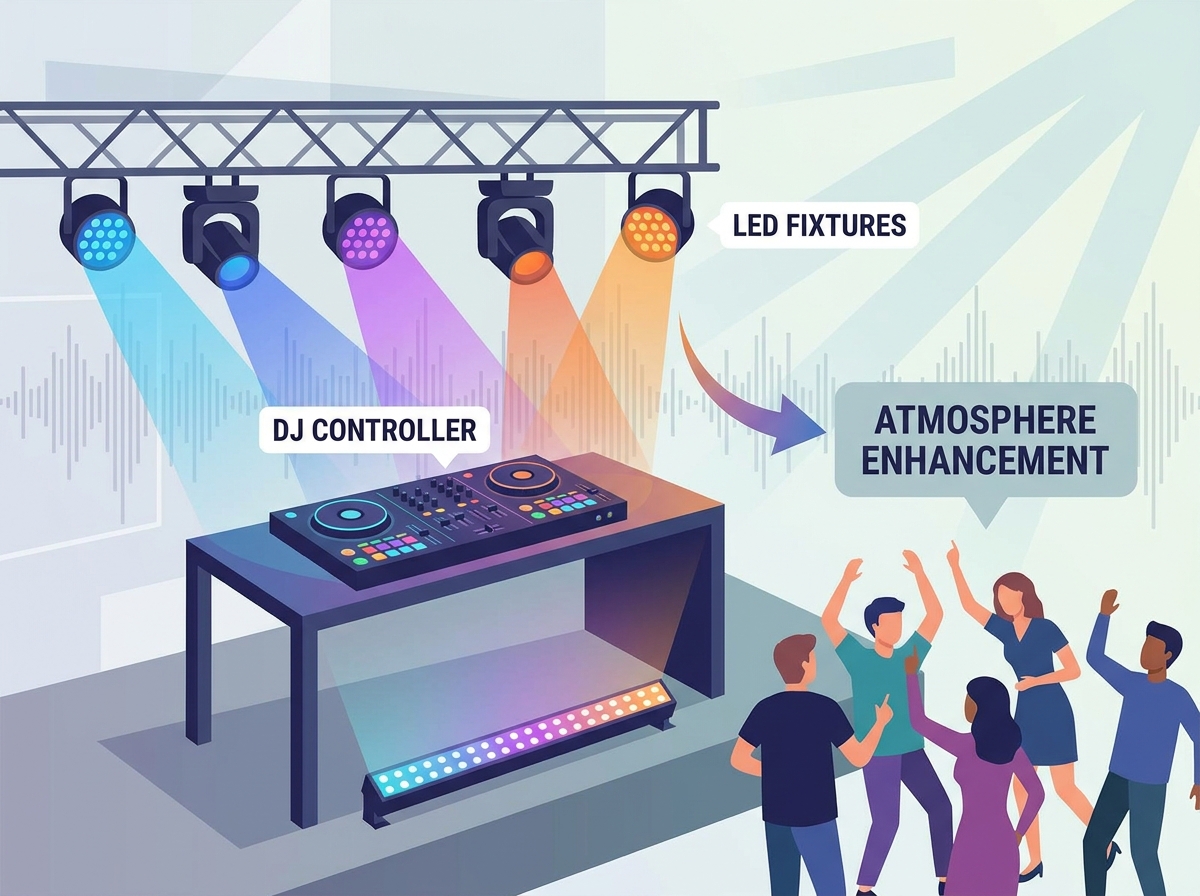
Wash lights establish the baseline color palette of a room. They fill dark spaces, eliminate harsh shadows, and set the foundational mood for the event. Traditional Par cans project a circular beam, ideal for spotting specific architectural columns or highlighting a cake table. Linear LED light bars provide wider, more even coverage. They excel at wall up-lighting and flooding dancefloors with uniform color. A proper DJ Party Lighting rig always starts with a strong wash foundation before adding any movement or effects.
Color mixing technologies determine the richness of your output. Basic RGB (Red, Green, Blue) fixtures struggle to produce warm whites or pastels, often resulting in a muddy, synthetic look. RGBW adds a dedicated white diode for cleaner tones and brighter output. RGBA incorporates amber, which is mandatory for achieving warm golds, natural skin tones, and matching premium event themes like weddings. Hex-color LEDs add UV into the mix. UV diodes make fluorescent materials pop and provide deep, vibrant purples that standard RGB simply cannot replicate.
Moving head lights create dynamic DJ lighting effects through programmable movement, colors, and beam control. Spot fixtures project sharp patterns and gobos, wash fixtures provide broad color coverage, and beam fixtures produce narrow, high-intensity light beams. DMX control helps synchronize movements with music, while haze can enhance visible aerial effects where permitted.
DJ effect lighting adds visual energy through rotating derby beams, strobe flashes, and laser patterns. These fixtures are most effective during musical drops, choruses, and high-energy dance moments. Controlled timing and moderate use help prevent visual fatigue, while laser and strobe effects require appropriate safety precautions to protect guests.
Battery-powered pixel tubes and LED strips represent a massive trend in event production. These fixtures frame the DJ booth or stage with clean, modern lines. They operate as visual eye-candy rather than room illuminators. Geometric lighting adds modern visual depth to your setup, allowing for complex pixel-mapping chases that run up and down the tubes.
Pixel tubes do not require atmospheric haze to look impressive. They glow vibrantly on their own, making them perfect for strict venues that ban fog machines. You can mount them vertically on floor stands, hang them horizontally from trussing, or attach them directly to the DJ facade to create a futuristic, high-end aesthetic.
Positioning fixtures correctly maximizes room coverage. You must understand the geometry of your beam angles. Wide wash lights with 40-degree beam angles belong near the perimeter, angled upward to graze walls. Tight spots with 10-degree angles belong on elevated trussing, aimed at the floor. Never position high-intensity fixtures at eye level. Blinding guests ruins their experience and creates harsh, unflattering shadows in event photography. Angle lights slightly above the crowd's heads or directly down onto the floor.
Strategic placement dictates the room's energy. Up-lighting focuses on architectural enhancement. Placing fixtures at the base of walls, pillars, or drapery creates a sophisticated perimeter glow. This technique makes rooms feel larger and more immersive, transforming sterile banquet halls into customized event spaces. Down-lighting focuses on dancefloor energy. Truss-mounted fixtures aimed downward isolate the dancing area. This creates a dedicated zone for high-energy movement while leaving the rest of the room ambient for conversation and dining.
The DJ booth should serve as the visual centerpiece of the room. Symmetrical fixture placement achieves this naturally. Place identical totems or stands on the left and right sides of your table. Mirror the movements of your fixtures in your DMX software. If the left moving head pans outward, the right should pan outward as well. This symmetry draws the audience's eyes toward the performer, establishes a professional stage presence, and looks significantly better in photos than a random assortment of lights scattered unevenly.
Sound-active lighting uses built-in microphones to synchronize colors and effects with music, making it suitable for budget-friendly events and simple DJ setups. However, background noise and limited cue control can affect accuracy. For weddings and corporate events requiring precise lighting transitions, DMX-controlled systems offer greater reliability and flexibility.
Hardware DMX controllers provide direct control through physical faders, making them suitable for live lighting adjustments. Software-based lighting systems offer flexible programming, automated effects, and integration with compatible DJ software. Choosing between them depends on event complexity, operator experience, budget, and the level of synchronization required.
Comparison of Lighting Control Methods | |||
Control Method | Setup Speed | Customization | Ideal Use Case |
|---|---|---|---|
Sound-Active | Instant | None | House parties, budget gigs |
Hardware DMX | Slow | High | Static stages, dedicated operators |
Software DMX | Moderate | Very High | Mobile DJs, synchronized shows |
Guerrilla lighting design relies on wireless transmitters and receivers. You can place fixtures anywhere in the room without running hundreds of feet of signal cable across doorways and high-traffic areas. This allows for on-the-fly, dynamic adjustments directly from the booth. You can change the entire room's color with one button press, instantly shifting the mood from a warm dinner setting to a vibrant dance party.
You must evaluate the reliability of 2.4GHz wireless DMX. Crowded RF environments pose a threat. Venues with heavy Wi-Fi traffic, wireless microphones, or hundreds of cell phones can cause signal interference. Using dual-band transmitters or keeping a clear line of sight between the transmitter and receivers mitigates latency and dropouts. Always elevate your transmitter above head height to ensure the signal reaches the fixtures without human bodies absorbing the RF waves.
Lithium-ion batteries power modern wireless LED fixtures. You must analyze their true lifespan. Most batteries provide 300 to 500 charge cycles before capacity drops significantly. A fixture that lasts 10 hours on day one might only last 6 hours after two years of heavy use. You must account for the replacement costs associated with degrading batteries. Always charge fixtures fully before storage to maintain cell health, and never leave them sitting in a depleted state for months in a cold warehouse.
Battery-powered fixtures carry a significant upfront premium. You pay for the internal power supply, the battery management system, and the wireless receiver. Compare this premium against the long-term savings. You save money on gaffer tape, heavy extension cords, and DMX cables. More importantly, you save hours of setup labor. If wireless fixtures allow you to book an extra gig per weekend because of faster turnarounds, or allow you to operate without hiring a setup assistant, the investment pays for itself rapidly.
A fully wireless rig is not always necessary or practical. Hybrid deployments offer the best of both worlds. Use wired fixtures for your primary stage lighting. Moving heads and high-output strobes draw too much power for efficient battery operation and require constant mains power. Reserve your wireless fixtures for perimeter up-lighting and architectural accents. This strategy ensures maximum output where it counts while maintaining a clean, cable-free room perimeter. A well-planned DJ lighting setup balances power needs with deployment speed, utilizing the right tool for each specific zone of the venue.
Audit your current power and transport capacities to determine the maximum fixture weight and amperage your operation can safely handle.
Map out your DMX universe requirements based on your desired fixture count and channel modes to ensure your controller can handle the data load.
Upgrade your foundational wash lighting with high-CRI, hex-color LED fixtures before investing in complex moving heads or lasers.
Implement a standardized cable management and rigging safety protocol, including mandatory safety cables and sandbags for all elevated fixtures.
A: Yes. DMX separates amateur sound-active chaos from professional synchronization. It allows you to control colors, movements, and blackouts precisely. Without DMX, fixtures operate randomly, often clashing with the music's tempo and the event's mood. Software-based DMX makes this integration easier than ever.
A: Generally, no. Budget fixtures suffer from poor durability, inaccurate color mixing, and unreliable DMX connectivity. They often use cheap plastic housings that break during transport. Investing in professional-grade fixtures prevents mid-event failures and provides a much better return on investment over time.
A: A baseline formula is one wash light for every 10 to 15 feet of wall space. For a standard 150-person room, 12 to 16 LED par cans or light bars usually provide a rich, immersive perimeter glow. Adjust based on the room's specific architecture and color darkness.
A: Yes, if managed correctly. High-quality fixtures easily run for 8 to 12 hours on a single color. However, running all diodes at full intensity (stark white) drains the battery much faster. Always check the manufacturer's capacity ratings and maintain strict charging protocols between events.
A: An LED Par projects a circular, concentrated beam, making it ideal for spotting specific columns or tight spaces. An LED Light Bar features a linear footprint and a wider beam angle. Bars are superior for washing wide sections of walls or flooding large dancefloors evenly.
A: Haze makes light beams visible in the air. Without it, beam and laser effects lose their mid-air impact and only show as dots on surfaces. If haze is banned, you must rely on surface projection (gobos), pixel tubes, and heavy wash lighting to create visual interest.
A: Yes. DMX512 is a universal protocol, so different brands can communicate on the same network. However, matching exact color temperatures (like a specific warm white) across different brands can be difficult due to varying diode qualities and internal color mixing profiles.