Views: 0 Author: Site Editor Publish Time: 2026-10-13 Origin: Site
The convergence of entertainment technology and permanent infrastructure redefines building facades. We now push exterior designs beyond static washes into dynamic, theatrical displays. Traditional fixtures offer longevity and low maintenance, but they lack the complex beam control, rapid movement, and high-impact visual effects required for modern experiential facades. Stage lights provide these features yet introduce significant challenges regarding weather resistance, thermal management, and continuous operational reliability. To successfully deploy theatrical fixtures in permanent exterior environments, specifiers must rigorously evaluate environmental ratings, control system interoperability, and long-term maintenance liabilities. This guide breaks down the technical criteria for integrating stage lighting into exterior facade designs, helping you navigate the physical and digital hurdles of outdoor theatrical installations.
Environmental Durability is the Primary Bottleneck: Deploying stage lights outdoors requires strict adherence to IP65/IP66 ratings or the use of engineered climate-controlled enclosures to prevent catastrophic failure from moisture and particulate ingress.
Control System Bridging is Mandatory: Integrating theatrical DMX/Art-Net protocols with standard building management systems (DALI, KNX) requires dedicated gateways and automated scheduling hardware.
Maintenance Liabilities Increase Exponentially: Moving parts (pan/tilt motors, internal gobos, framing shutters) in stage lights require aggressive, scheduled maintenance cycles compared to solid-state architectural fixtures.
Compliance Requires Strict Masking: High-output theatrical fixtures risk violating local light pollution ordinances and Dark Sky compliance unless heavily mitigated through precise programming and physical snoots/louvers.
Table of Contents
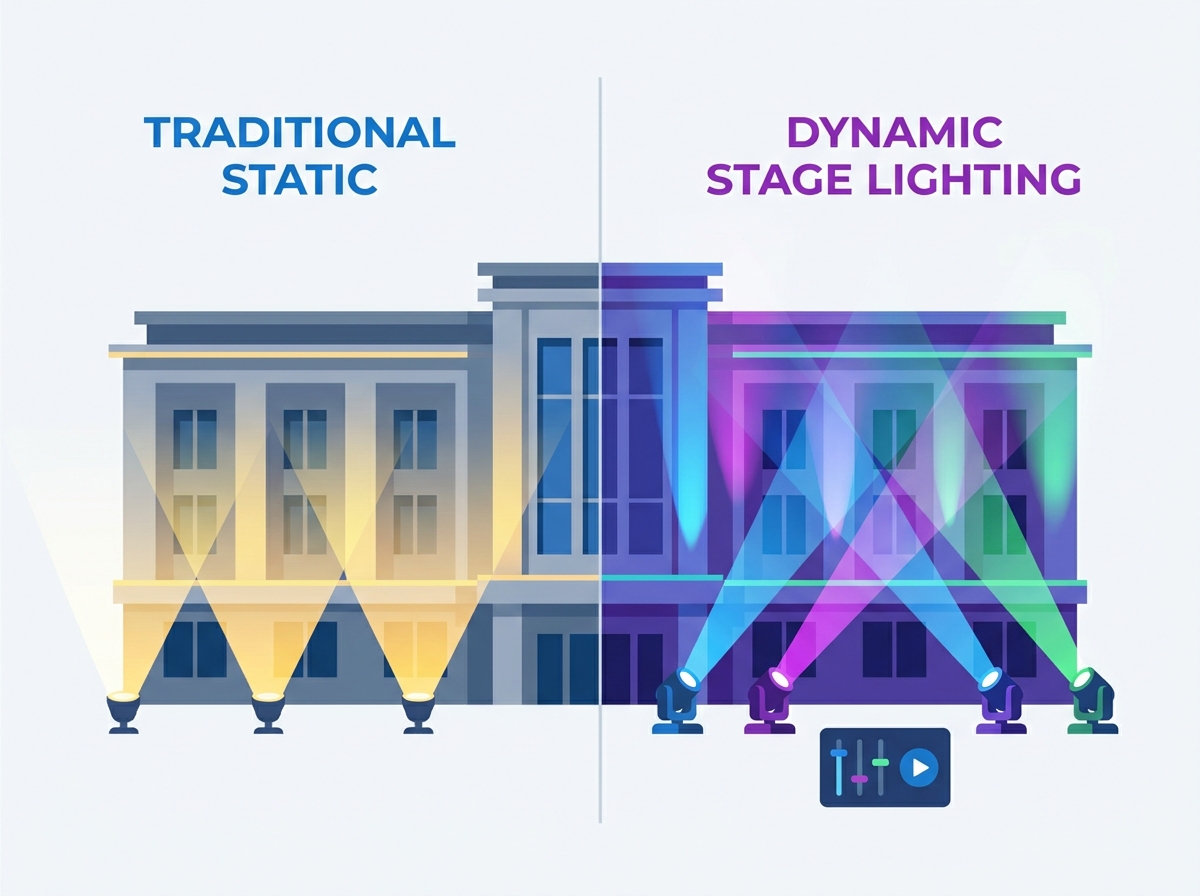
Dynamic facade lighting is transforming building exteriors from static illumination into interactive visual displays. Modern systems combine architectural lighting with theatrical effects to support brand promotion, seasonal events, and landmark illumination.
Traditional architectural lighting provides stable, energy-efficient illumination but offers limited flexibility for dynamic effects. Fixed beam angles, slower color transitions, and the absence of motorized movement make conventional fixtures less suitable for complex projections and synchronized lighting shows.
IP-rated theatrical lighting fixtures expand creative possibilities through high-output illumination, rapid color changes, and programmable movement.
Lighting Type | Main Capability | Typical Application |
|---|---|---|
Static LED Wash Lights | Consistent facade illumination | Daily architectural lighting |
Moving Head Lights | Dynamic beams and movement | Events and landmark lighting |
LED Profile Lights | Sharp patterns and logo projection | Branding and seasonal displays |
Pixel-Mapped LED Systems | Coordinated visual effects | Interactive building facades |
Successful dynamic facade lighting systems should balance visual impact with long-term reliability. Key considerations include brightness under ambient light, accurate color reproduction, suitable IP ratings, programmable control, and compatibility with facade materials such as glass, metal, and masonry.
By combining reliable architectural fixtures with dynamic theatrical lighting, designers can create flexible building exteriors suitable for both everyday illumination and special events.
Commercial fixtures feature discrete profiles designed to blend seamlessly into building structures. Manufacturers engineer them to hide within architectural reveals or behind parapet walls. Stage lights utilize bulky, utilitarian chassis built for temporary rigging and maximum output. Their large yokes and prominent cooling vents make them difficult to conceal on a clean facade.
Mounting heavy theatrical fixtures on building exteriors requires rigorous structural engineering. Installers account for significant wind load calculations due to the larger Effective Projected Area (EPA) of moving heads. Custom rigging brackets secure these heavy units safely to structural steel. Engineers implement vibration dampening systems because continuous motorized panning and tilting generate kinetic energy that transfers into the building structure over time.
Standard exterior fixtures run continuously using passive heat sinks. Extruded aluminum housings draw heat away from the LED engine naturally. This solid-state approach ensures decades of reliable operation without mechanical failure. Theatrical fixtures are designed primarily for show-only duty cycles rather than 24/7 continuous operation.
Stage lights rely heavily on active cooling fans to manage extreme heat loads. High-wattage LED engines generate thermal levels that passive cooling cannot handle. These mechanical fans introduce significant potential failure points when exposed to outdoor elements. Dust, pollen, and moisture seize fan bearings. When active cooling fails, the fixture quickly overheats and shuts down to prevent internal damage.
Stage lights offer ultra-precise, motorized zoom arrays and internal framing shutters. This allows for sharp edge control and dynamic beam shaping on the fly. Operators adjust the beam angle remotely to highlight different architectural features throughout the night. Internal iris mechanisms narrow the beam into a tight, high-intensity shaft of light.
Traditional fixtures utilize fixed, interchangeable lenses. Installers select a specific beam angle during the initial specification phase. Changing the beam spread requires physical intervention to swap the optical media. They prioritize long-term reliability over on-the-fly adjustability. This fixed approach works perfectly for static washes but fails when the facade requires adaptable focal points.
Technical Feature | Traditional Fixtures | Theatrical Stage Fixtures |
|---|---|---|
Cooling Mechanism | Passive (Extruded Aluminum Heat Sinks) | Active (Mechanical Fans, Liquid Cooling) |
Optical Control | Fixed Lenses, Manual Swaps | Motorized Zoom, Internal Framing Shutters |
Movement | Static, Manual Focus | Motorized Pan and Tilt (540°/270°) |
Control Protocol | DALI, 0-10V, Phase Cut | DMX512, Art-Net, sACN |
Maintenance Frequency | Minimal (Cleaning only) | High (Quarterly mechanical inspections) |
Projection mapping and gobo lighting transform building facades with logos, patterns, and animated effects. LED profile fixtures with adjustable focus and rotating gobos create detailed projections, while multiple fixtures can produce larger visual displays. Proper projection distance, surface characteristics, and alignment are essential for clear results.
IP-rated moving head lights create dynamic beams, sweeping effects, and architectural highlights. Programmable pan and tilt movements allow fixtures to follow rooflines, columns, and building outlines. These systems are suitable for landmarks, entertainment venues, and special events requiring flexible lighting effects.
High-output theatrical wash lights provide powerful facade illumination and flexible color-changing effects. Fixtures with CMY color mixing can produce a broad range of colors for branding, architectural displays, and synchronized lighting shows. Adjustable brightness and rapid color transitions support dynamic visual presentations.
Outdoor facade lighting requires suitable weather protection to withstand dust, rain, temperature changes, and UV exposure. IP65 or IP66 fixtures are commonly selected for exposed installations, while indoor fixtures require appropriately engineered protective enclosures. Coastal environments may also require additional corrosion-resistant materials and coatings.
Facade lighting control systems commonly use DMX512, Art-Net, or sACN for dynamic effects and synchronized operation. Protocol gateways can connect theatrical lighting with building automation systems such as DALI or KNX. Programmable controllers and astronomical timers enable automatic lighting schedules and reduce manual operation.
Permanent facade lighting systems must balance visual performance with energy efficiency and local regulations. High-output fixtures can increase electricity consumption, while scheduled operation and efficient LED technology help manage energy costs. Beam shutters and movement limits also help reduce unwanted light spill into surrounding areas.
Outdoor stage lighting fixtures require regular maintenance to prevent performance degradation caused by moisture, dust, and mechanical wear. Cleaning lenses, inspecting seals, checking moving components, and monitoring cooling systems help extend equipment life. Remote Device Management (RDM), where supported, enables fault monitoring and preventive maintenance.
Facade lighting security is important for fixtures installed in accessible public areas. Tamper-resistant mounting hardware, protective enclosures, elevated installation positions, and concealed cabling help prevent theft and accidental damage. Secure installation also improves public safety and long-term system reliability.
Reliable lighting automation depends on stable network connections, suitable controllers, and effective fault protection. Backup control systems, predefined fallback lighting states, and remote monitoring help reduce unexpected outages. Proper movement limits prevent automated fixtures from directing beams toward roads, nearby buildings, or other sensitive areas.
On-site lighting mockups help verify fixture performance before permanent installation. Nighttime testing allows designers to evaluate brightness, projection clarity, color accuracy, and beam coverage under actual environmental conditions. Testing fixtures at the intended mounting distance helps identify limitations and reduce costly installation changes.
Hire a specialized lighting integrator to conduct a comprehensive site survey and structural wind-load analysis for heavy moving heads.
Execute a live, nighttime mockup of the proposed theatrical fixtures against the actual facade material to verify color rendering and ambient light punch-through.
Draft a detailed control system schematic that maps the protocol translation between high-speed DMX networks and standard building management systems.
Program strict software limits on pan and tilt movements to guarantee continuous compliance with local light pollution ordinances and Dark Sky regulations.
Implement a proactive, quarterly maintenance schedule utilizing RDM monitoring to protect motorized components from environmental degradation.
A: No, unless they are installed inside engineered, climate-controlled, and IP-rated enclosures. Using IP20-rated indoor fixtures outdoors without protection results in immediate failure from moisture, condensation, and dust ingress. Always specify native IP65/IP66 fixtures for direct outdoor exposure.
A: Stage lights typically use DMX or Art-Net protocols. To integrate them, you must use a dedicated lighting control engine or protocol gateway. This hardware translates slow building commands from DALI, KNX, or simple contact closures into the high-speed DMX triggers required by theatrical fixtures.
A: While the internal LED engine lasts up to 50,000 hours, the motorized components require servicing every 12 to 24 months. Outdoor environmental stress, temperature fluctuations, and continuous mechanical movement make their practical lifespan highly dependent on rigorous, scheduled maintenance routines.
A: Generally, no, as they are designed for high output and aerial effects. However, compliance is achieved by utilizing internal framing shutters to restrict light strictly to the facade. Programmers must limit pan and tilt ranges via software and apply physical snoots to prevent light trespass.
A: DALI is a slow, low-bandwidth protocol ideal for standard exterior lighting functions like basic on/off and slow dimming. DMX is a high-speed, high-bandwidth protocol required for stage lights to control rapid color changes, complex motorized movement, and sequential effects smoothly without lag.
A: No. Traditional exterior lighting often carries a five-to-ten-year warranty due to its highly reliable solid-state nature. Stage lighting typically carries a one-to-two-year warranty because of its complex moving parts, active cooling fans, and intended use in temporary touring setups.